§ Chapter IV · The investigations · MMXXIII — MMXXVI

Research

Four investigations across hydrochemistry, conservation computer vision, and marine geochemistry — one in preparation, one in the field, one in the bound report, one in the archive. The build artifacts these investigations produced live on Projects; this chapter is about the science.

§ ORCID · 0009-0005-4168-9726 ↗

§ 4.1 · Four investigations
§ Plate 01 · Manuscript in preparation In prep · 2026
Currently · Manuscript in preparation

Heavy Metal Contamination in the Pilcomayo River Basin

Spatiotemporal dynamics, sediment-water partitioning, and geochemically targeted remediation strategies.

Project
Pilcomayo Basin · Bolivia · Argentina · Paraguay
Role
First author · independent extension of the River Remedy thesis
Advisor
Dr. Arturo Keller · UCSB Bren
Status
Manuscript in preparation · 2026

The Pilcomayo descends from the Bolivian Andes through Argentina and into Paraguay across an 850 km transboundary corridor, gathering sediment, silver, and a long historical load of cadmium, lead, and zinc from upstream mining. The investigation asks how those metals partition between dissolved phase, suspended sediment, and the river bed across space and time — and what that partitioning behavior implies for site-specific remediation.

The analysis draws on 1,436 samples across 46 monitoring stations spanning eight years (2016–2024), contributed by the Comisión Trinacional para el Desarrollo de la Cuenca del Río Pilcomayo. Spatiotemporal partitioning is modelled in Spyder 6 Python 3 using a coupled hydrological–geochemical framework, with field campaigns paired against discharge regimes for the wet, dry, and shoulder seasons.

Findings track which reaches and which seasons drive the highest dissolved-metal load, and use that mapping to evaluate where geochemically targeted remediation interventions — wetland buffer reactivation, sediment capping, and source-side controls — are likely to deliver the largest reduction in downstream exposure for the indigenous communities and agricultural regions that depend on the river. Findings have additionally been presented to Diputada María Ángela Ruíz Farfán during her visit to UCSB.
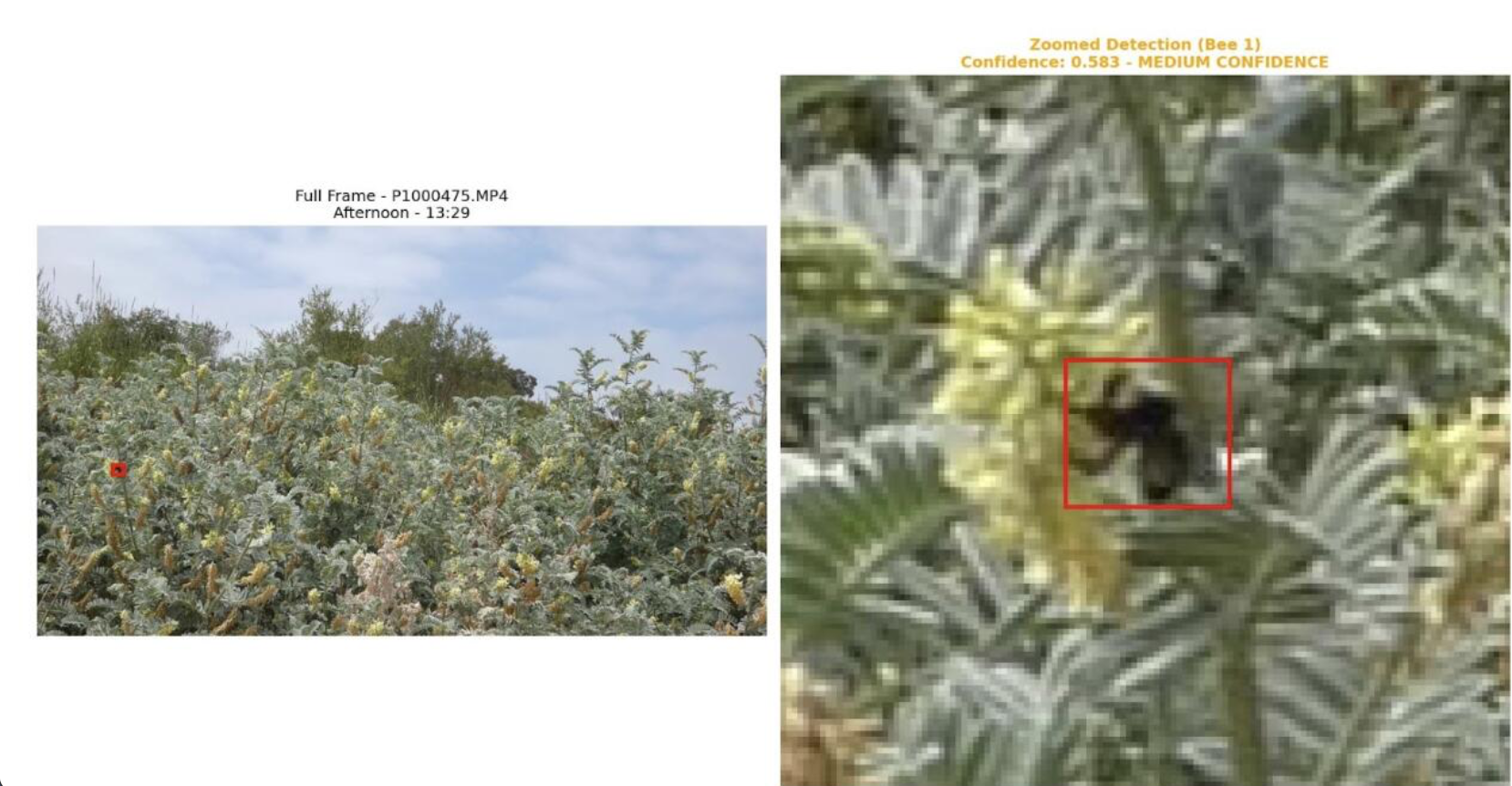
YOLOv8 pollinator detection model — bounding box inference on native bee at NCOS restoration site
§ Plate 02 · Field study · 2025 Field season · summer 2025

Automated Pollinator Monitoring with YOLOv8 at NCOS

Computer-vision visitation surveys for two federally endangered coastal plant species.

Project
NCOS pollinator visitation surveys
Role
Research assistant · field protocol design · model training · undergraduate mentorship
Advisors
Dr. Katja Seltmann · Dr. Chris Evelyn · UCSB Cheadle Center
Status
Field season complete · 2025 · Featured in Cheadle Restoration Register

The study asks whether automated computer vision can credibly stand in for hand-tallied pollinator visitation surveys for two federally endangered coastal plant species — Ventura marsh milk-vetch (Astragalus pycnostachyus var. lanosissimus) and salt marsh bird's-beak (Chloropyron maritimum ssp. maritimum) — at the NCOS restoration site in Goleta, California.

Across nine weeks of the summer 2025 field season, two Panasonic Lumix cameras and a long-run "Doug" camera were deployed across four yarn-marked quadrants for three one-hour shifts daily — morning, mid-day, afternoon — with site order randomized and weather, wind speed, and on-site pollinator activity logged for every session. The result was more than 200 hours of raw video and a hand-built ground-truth log: timestamped time | quadrant | bumblebee count entries keyed to a numbered grid, against which every detection downstream is checked.

The training pipeline I built is the core of my contribution. Frames were extracted from raw video at 1–2 second intervals using OpenCV; a 165-frame subset (101 frames in the first pass, 64 in a second) was hand-annotated in Matplotlib, with every clearly visible Bombus getting a manually drawn bounding box and each annotation cross-checked against the ground-truth count log. Annotations were split 70 / 20 / 10 across train / validation / test.

A YOLOv8 detector (PyTorch · Ultralytics) was trained iteratively on this set — a 50-epoch baseline, a 150-epoch v2, and a 200-epoch v23 — with each iteration evaluated on withheld videos. The 150-epoch model reached mAP50 = 0.745, precision = 0.878, and recall = 0.648, with the precision–confidence curve plateauing at 1.00 above ~0.39 confidence; on a withheld test video the model identified bees at 100% detection rate at 1.000 confidence. A follow-on run is comparing this manually annotated dataset against a synthetic-overlay approach — high-resolution bumblebee cutouts composited onto vegetation stills with auto-generated bounding boxes — with a manuscript on the comparison in preparation under Dr. Katja Seltmann and Dr. Chris Evelyn at the Cheadle Center.

§ Plate 03 · Senior thesis · undergraduate B.A. · UCSB · June 2024

Remediating Ocean Acidification: Calcium Carbonate from Discarded Bivalves

Reintroducing ground bivalve shells to enhance ocean alkalinity — and the dissolved-oxygen trade-off that came with it.

Project
Bivalve-shell alkalinity enhancement · UCSB reef tanks
Role
Sole author · experimental design · field collection · benchtop chemistry
Advisor
Kelsey Dowdy · UCSB Environmental Studies · with CCBER (Alison Rickard, Roost Lab) for instrumentation
Status
Awarded · June 2024

The thesis asks whether calcium carbonate from discarded bivalve shells — sourced through a partnership with Hendry's Boathouse, a local Santa Barbara seafood restaurant — can meaningfully counter ocean acidification when reintroduced into marine systems as a ground material. The framing draws on indigenous shell-stewardship practices from the Bodega Bay community alongside contemporary aquatic chemistry.

Ground bivalve shells were dosed into reef-tank treatments at UCSB and tracked over time against control tanks for pH, dissolved oxygen, conductivity, and salinity using YSI and pH meters provided by CCBER. A MANOVA evaluated the joint treatment effect across response variables.

Findings: ground shell additions did raise pH, supporting the alkalinity-enhancement hypothesis — but a measurable decrease in dissolved oxygen was observed alongside the pH rise, indicating a real biogeochemical trade-off rather than a clean win. The thesis ends by recommending future work on shell dispersal methods that maximize the alkalinity benefit while characterizing and mitigating the DO drawdown — particularly mechanistic and long-term studies.

If the preview doesn't load, click to download.

§ Plate 04 · Master's thesis report · group authorship 2026 · UCSB Bren

River Remedy — master's thesis report

Group capstone investigation of pollution sources, contaminant transport, and remediation strategy.

Project
River Remedy master's thesis (Pilcomayo case study)
Role
Co-author · hydrochemistry analysis lead · spatial figures · technical-writing voice
Advisor
Dr. Arturo Keller · UCSB Bren
Status
Final report submitted · April 2026

A 141-page graduate-group investigation that synthesizes field data, environmental chemistry, and policy analysis into long-term remediation recommendations for a pollution-stressed river system. Group authorship is attributed inside the document; my contribution centered on the heavy-metals hydrochemistry chapters, the spatial figures, and carrying a consistent technical-writing voice across the report.

The Pilcomayo manuscript in preparation (Card 01) is my solo first-author extension of this group work — taking the heavy-metals analysis I led for the report and developing it into a standalone, peer-review-targeted paper.

If the preview doesn't load, click to download.