Where a Metal Sits Defines the Risk Downstream
A metal dissolved in the water column is an immediate hazard for the communities who drink, fish, and farm along 800 km of the Pilcomayo. A metal locked in riverbed sediment is a slower, generational threat — deferred, not gone. The partition coefficient KdThe ratio of a metal's concentration on sediment to its concentration in water at equilibrium. A higher Kd means more of the metal is held in the sediment and less is dissolved in the water column. is the number that separates those two fates. Across this basin, Kd varies 10× across the four priority metals, a hierarchy with direct consequences for where contamination risk concentrates and which interventions can work.
From Water-Mobile to Sediment-Bound: Where Each Metal Lives
The four priority metals do not behave uniformly. Their median partition coefficients span nearly an order of magnitude — cadmium is roughly 8× more mobile than lead. This single diagram is the orientation frame for everything that follows: every mechanism, every control, every remediation decision maps back to where a metal sits on this spectrum.
Come back to this diagram as you read each metal's story. Every ρ value and remediation lever discussed below maps to a position on this spectrum.
One Ratio, Two Risks
Kd is the ratio of how much metal is in the sediment versus how much is dissolved in the water at the same location and time. A high Kd means the metal strongly prefers the solid phase — it accumulates in the riverbed, creating a long-term legacy reservoir that can remobilize during floods or chemical disturbances. A low Kd means the metal stays dissolved — it travels with the water, exposing communities far downstream right now.
Kd = Csed / Cwater
- Kd
- partition coefficient [L/kg]
- Csed
- metal concentration in sediment [mg/kg dry weight]
- Cwater
- metal concentration in water [µg/L]
Lead Binds 10× More Strongly Than Cadmium
The four metals span an order of magnitude in sediment affinity. This hierarchy directly determines which metals dominate water-column risk (low Kd = mobile) vs. sediment-bound legacy risk (high Kd = persistent).
→ Full story
→ Full story
→ Full story
→ Full story
Kd Summary Statistics by Metal
| Metal | n (pairs) | Median Kd (L/kg) | Mean Kd (L/kg) | Range (L/kg) | Std Dev |
|---|---|---|---|---|---|
| 265 | 1,667 | 11,294 | 5.25 – 548,000 | 47,612 | |
| 265 | 908 | 4,244 | 4.22 – 175,100 | 15,423 | |
| 265 | 664 | 12,260 | 2.76 – 1,321,000 | 84,643 | |
| 264 | 200 | 3,179 | 1.36 – 100,000 | 15,117 |
Wide ranges and high standard deviations — particularly for Pb and Zn — reflect the basin's dramatic geochemical gradient from acid mine-drainage headwaters (pH 3–5) to near-neutral downstream reaches (pH 7–8.5). Median values are more representative than means for these multi-order-of-magnitude distributions.
Four Metals, Four Stories
Each metal follows its own geochemical logic. The mechanisms verified here are not assumptions drawn from textbooks — they are the specific pathways that statistical analysis of 265 paired samples confirmed are operating in this basin, at the pH and mineral composition conditions that actually exist in the Pilcomayo.
Arsenic is bound across three oxide phases simultaneously — iron, manganese, and aluminum — making it one of the most geochemically anchored metals in the system at near-neutral pH. The textbook prediction holds: Fe(III) and Al(III) oxides adsorb arsenate [As(V)] through strong inner-sphere surface complexes, and the data confirm it (Fe ρ = +0.268, p < 0.0001; Al ρ = +0.212, p = 0.014).
The paradox is in the pH signal. Arsenic shows a negative pH correlation (ρ = −0.216, p = 0.0004), meaning retention is higher at low pH — the opposite of Cd, Pb, and most cations. This is chemically consistent: arsenate is an anion, and Fe/Al oxide surfaces carry a net positive charge below their point of zero charge (pH ~8), so acid conditions enhance arsenate adsorption. Retention collapses only when the oxide minerals themselves dissolve under extreme acidity (pH < 3.5), or when reducing conditions convert As(V) to the more weakly binding As(III). Both threats are real in the Potosí headwaters.
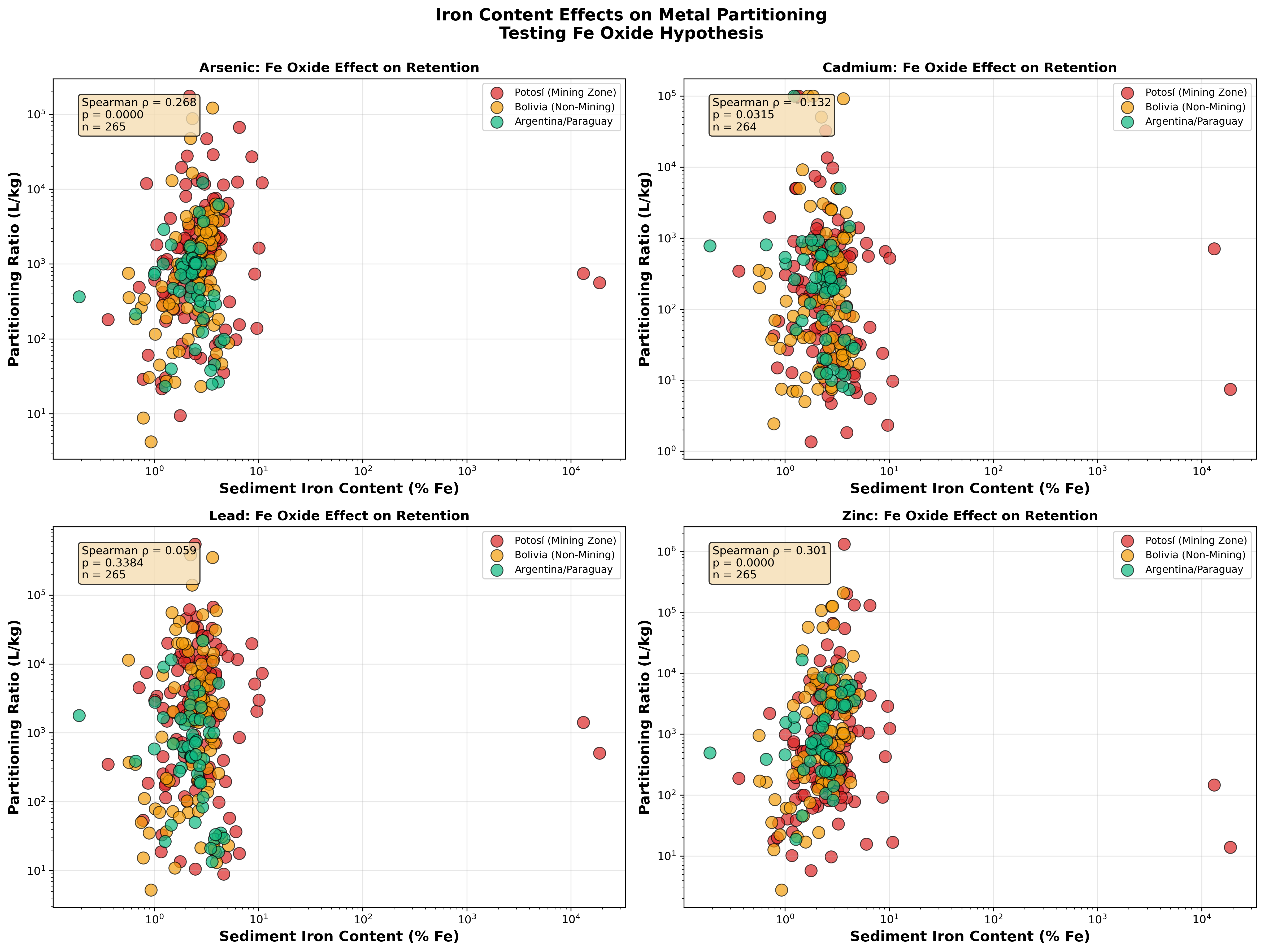
Sediment Fe content vs. Kd for all four metals. Arsenic (ρ = +0.268, p < 0.0001, n = 265) and Zinc (ρ = +0.301) show strong positive trends confirming Fe-oxide sorption. Cadmium shows a flat-to-negative trend — it does not bind to Fe oxides. Lead shows no systematic relationship (ρ = +0.059, p = 0.338, not significant).
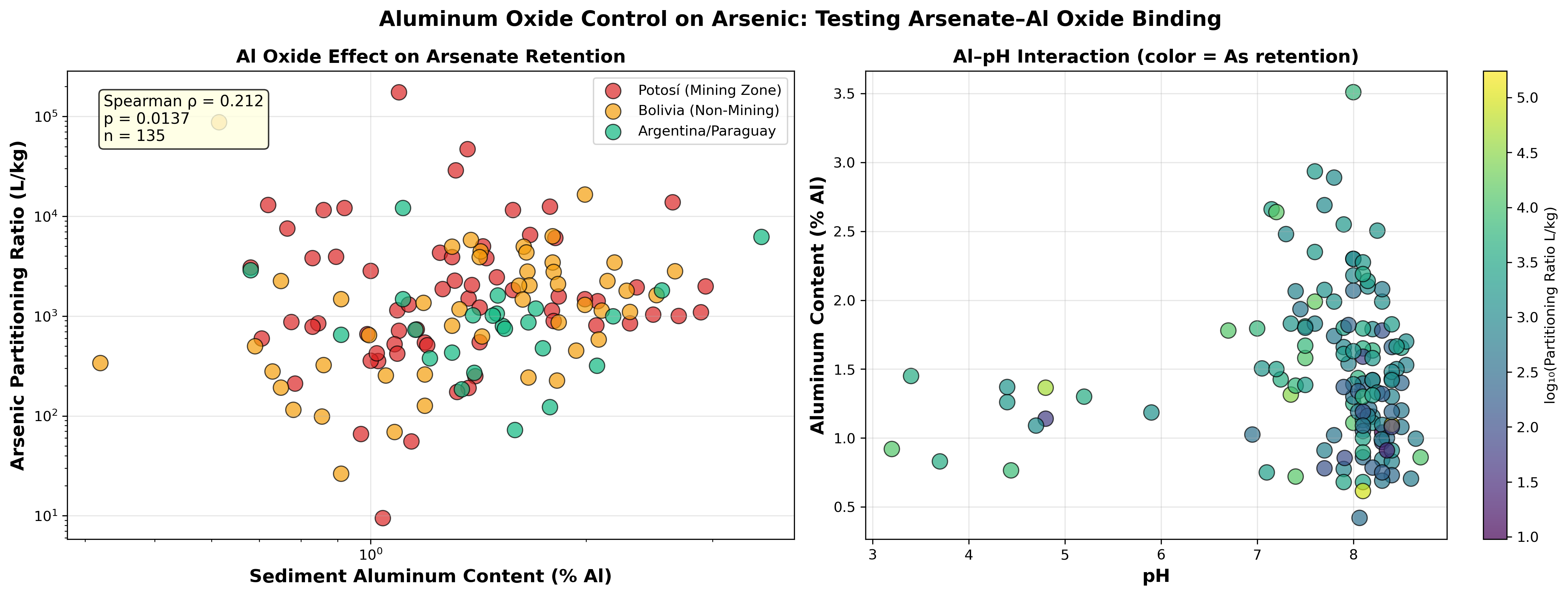
Al oxide content vs. As Kd (ρ = +0.212, p = 0.014, n = 135), with pH color-coded. High As retention concentrates at pH 3–5 with variable Al content — confirming that arsenate binds more strongly to positively charged Al-hydroxide surfaces at low pH. Retention collapses above pH 7 regardless of Al content, illustrating the anion-adsorption paradox.
Cadmium's binding chemistry defies the standard geochemical script for divalent cations. Where iron oxides are the dominant sorbent for most trace metals, Cd shows a statistically significant negative correlation with Fe content (ρ = −0.132, p = 0.031) — the more Fe in the sediment, the less Cd is retained. Manganese oxides show no relationship (ρ = −0.028, not significant). Cd is not using oxide surfaces at all.
Instead, Cd is controlled by calcium and phosphate minerals: Ca ρ = +0.318 (p = 0.0002, n = 135), P ρ = +0.355 (p < 0.0001). These are relatively soluble mineral phases that dissolve as pH drops. This explains both Cd's low median Kd (200 L/kg — the most mobile metal in the system) and its extreme sensitivity to acidification. Clay shows a strong negative correlation (ρ = −0.404, p < 0.0001), interpreted as sorption siteThe process by which a dissolved metal attaches to a solid surface (sediment particle, mineral phase). A 'sorption site' is one such attachment location; once all sites are occupied, additional metal stays in solution. saturation in clay-rich downstream sediments: metals from mining upstream have already occupied available exchange sites.
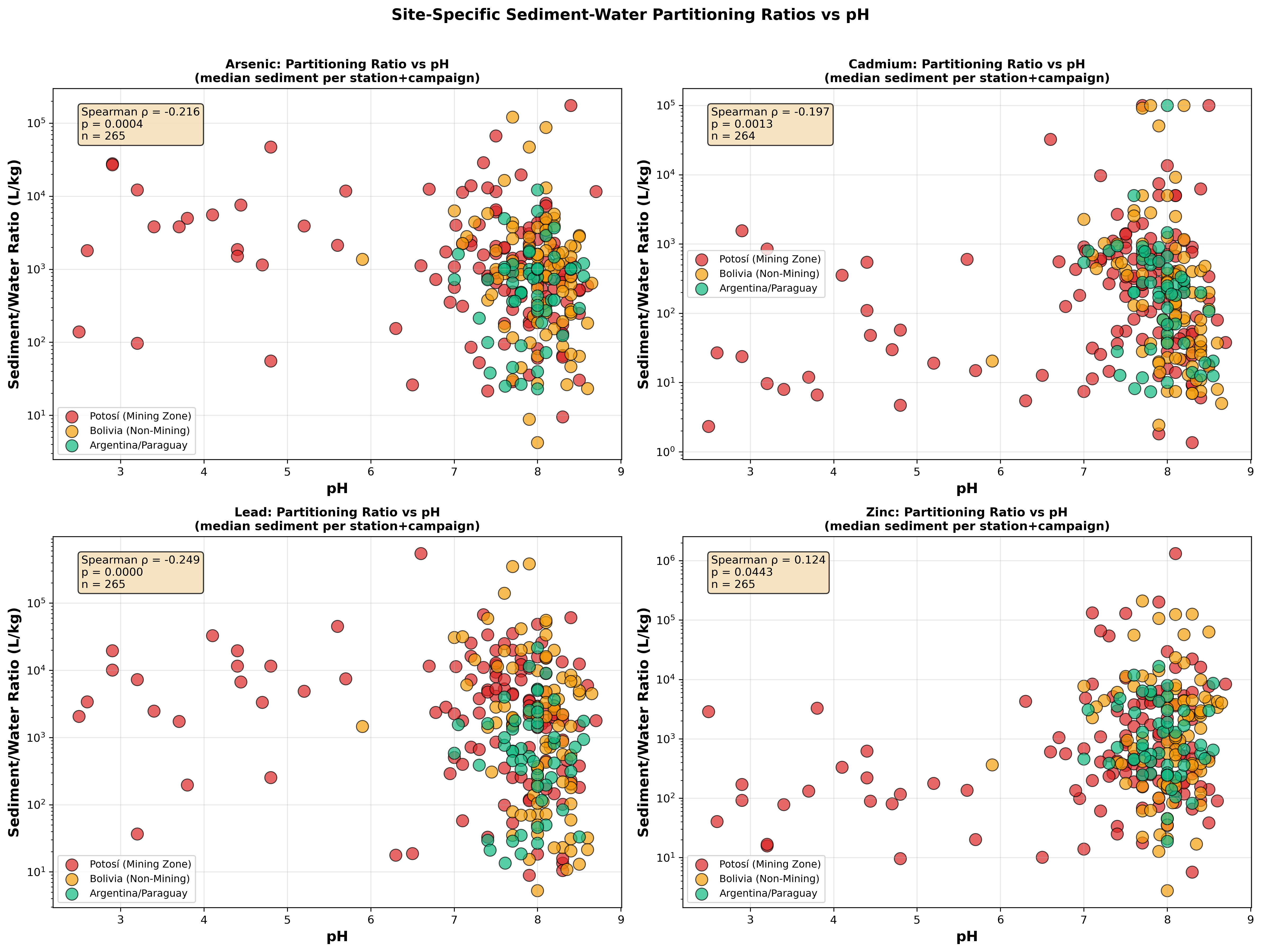
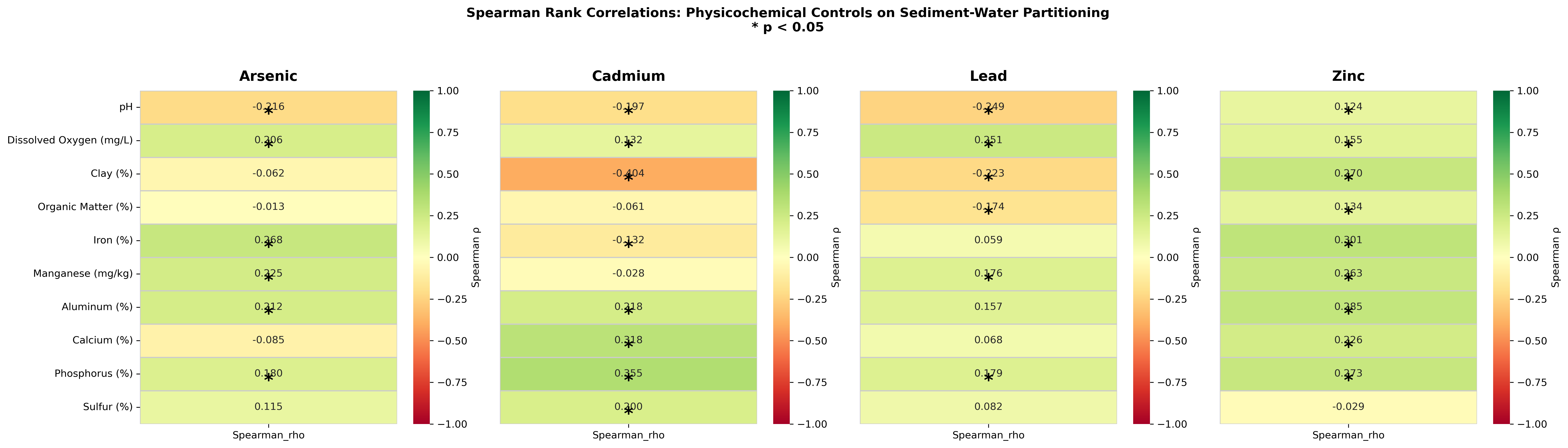
Kd vs. pH for all four metals across 265 sampling events. Cadmium (pH ρ = −0.197, p = 0.0013) shows a clear negative trend — as pH drops, Ca/P minerals that host Cd dissolve and Cd mobilizes into the water column. The basin's bimodal pH distribution (mining zone pH 3–5 vs. downstream pH 7–8.5) is the dominant spatial driver of Cd contamination risk.
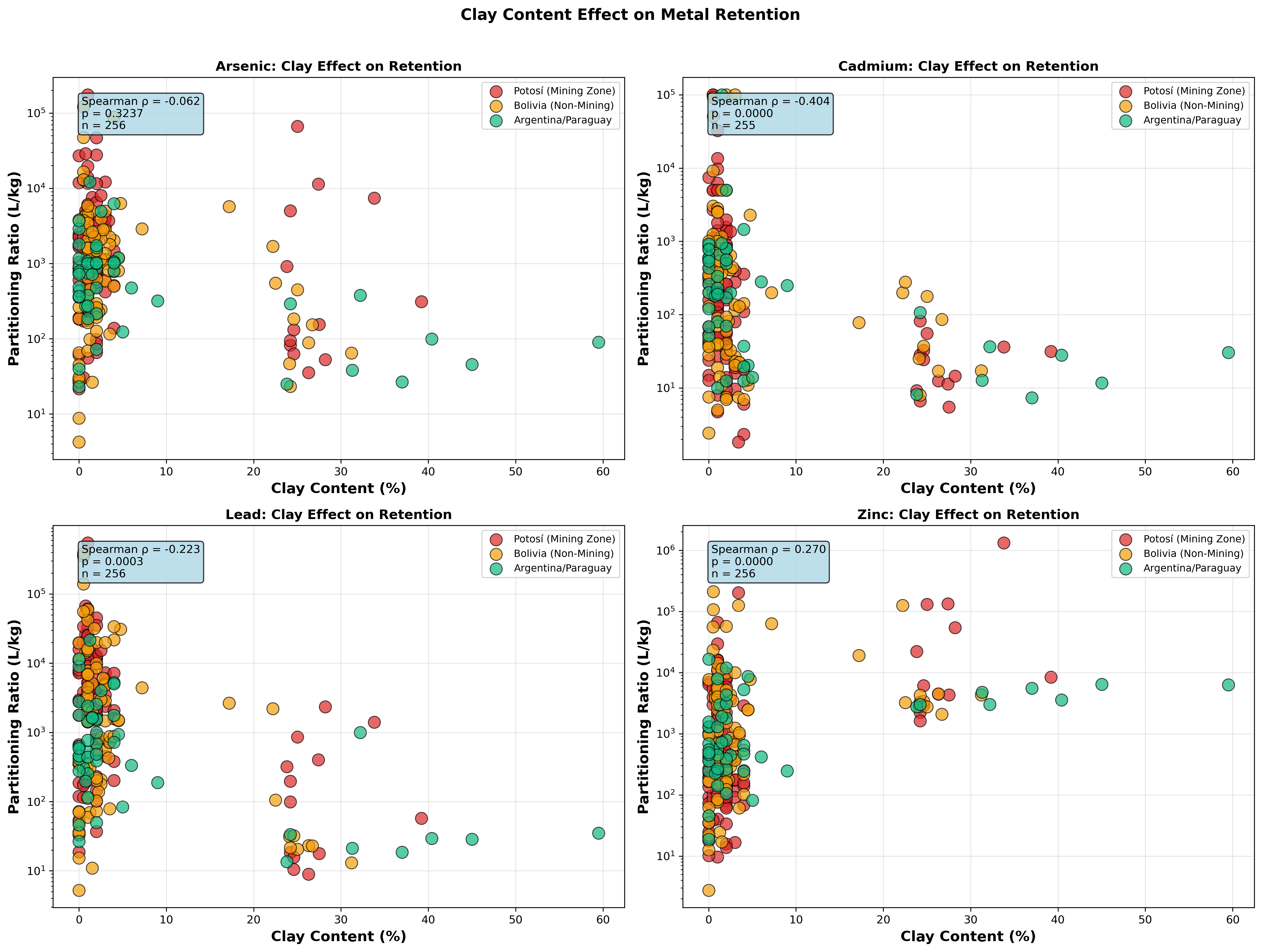
Clay content (%) vs. Kd for all four metals. Cadmium shows the strongest relationship in the dataset (ρ = −0.404, p < 0.0001, n = 255): clay-rich downstream sediments have accumulated decades of mining-derived Cd, saturating available sorption sites and suppressing Kd. Zinc shows the opposite (ρ = +0.270) — active cation exchange on clay surfaces — underscoring that the two metals operate through fundamentally different mechanisms.
Lead has the highest median Kd in the system — 1,667 L/kg — nearly 10× more tightly held than cadmium. At first glance, that looks reassuring. It is not. Pb's high sediment affinity comes with a critical vulnerability: the binding mechanisms that hold it are narrow and oxygen-dependent in ways that make Pb the metal most at risk from a single environmental disturbance.
Neither iron oxides (ρ = +0.059, p = 0.338 — not significant) nor aluminum oxides (ρ = +0.157, p = 0.069 — not significant) are verified controls for Pb in this system. The only confirmed binding pathways are manganese oxides (ρ = +0.176, p = 0.004) and phosphate minerals (ρ = +0.179, p = 0.038). Manganese(IV) oxides are the most redox-sensitive of the sediment mineral phases — they reductively dissolve the moment dissolved oxygen drops near zero. Pb also shows the strongest DO correlation of any metal in the system (ρ = +0.251, p < 0.0001). High Kd today, under current oxic conditions, does not guarantee Pb stays bound when flood-driven or hypoxic disturbances hit.
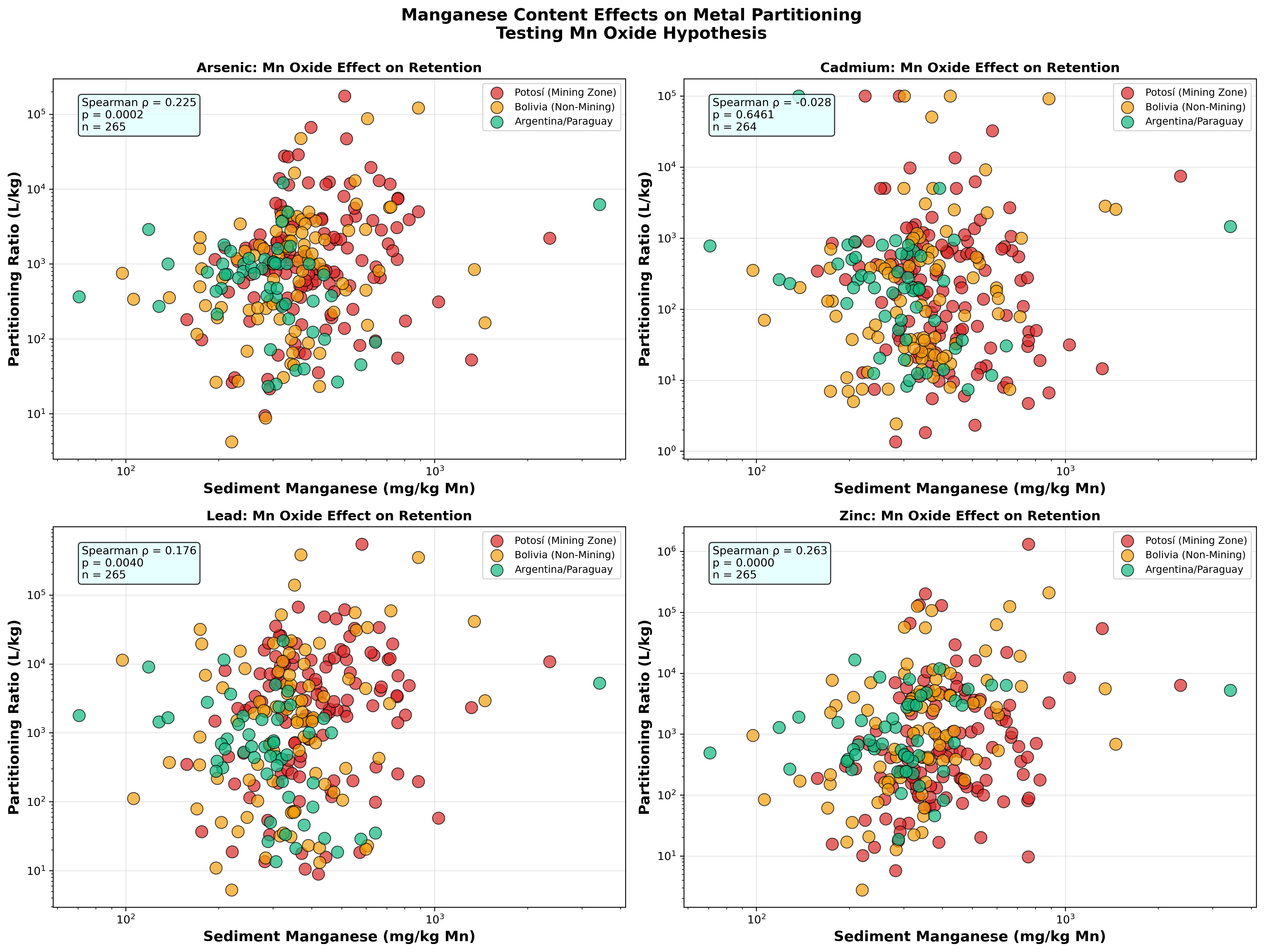
Sediment Mn content vs. Kd for all four metals. Lead shows a weak but significant positive trend (ρ = +0.176, p = 0.004, n = 265) — Mn oxides are the only verified oxide retention mechanism for Pb in this system. Arsenic (ρ = +0.225) and Zinc (ρ = +0.263) show stronger Mn relationships. Cadmium shows no Mn correlation (ρ = −0.028, not significant), consistent with its Ca/P-only retention pathway.
Zinc is the geochemically resilient outlier. Seven distinct binding mechanisms are statistically verified — the broadest mineral binding network of any metal in this system. Fe oxides (ρ = +0.301), Al oxides (ρ = +0.285), phosphate (ρ = +0.273), clay surfaces (ρ = +0.270), Mn oxides (ρ = +0.263), calcium minerals (ρ = +0.226), and even organic matter (ρ = +0.134, p = 0.032) all contribute. No other metal has a positive organic matter signal.
Zinc also shows a positive pH correlation (ρ = +0.124, p = 0.044) — unlike As, Pb, and Cd, higher pH slightly improves Zn retention. This is consistent with Zn²⁺ acting as a classical cation: deprotonation of surface hydroxyl groups at higher pH creates more negatively charged binding sites. The redundancy of binding pathways means Zn is resistant to single-pathway disruption: losing Fe oxide capacity (e.g., under reducing conditions) does not eliminate retention, because clay, Al, and phosphate pathways remain active. Zn is unlikely to cause acute water-column contamination spikes — its risk is chronic accumulation in sediment near the source.
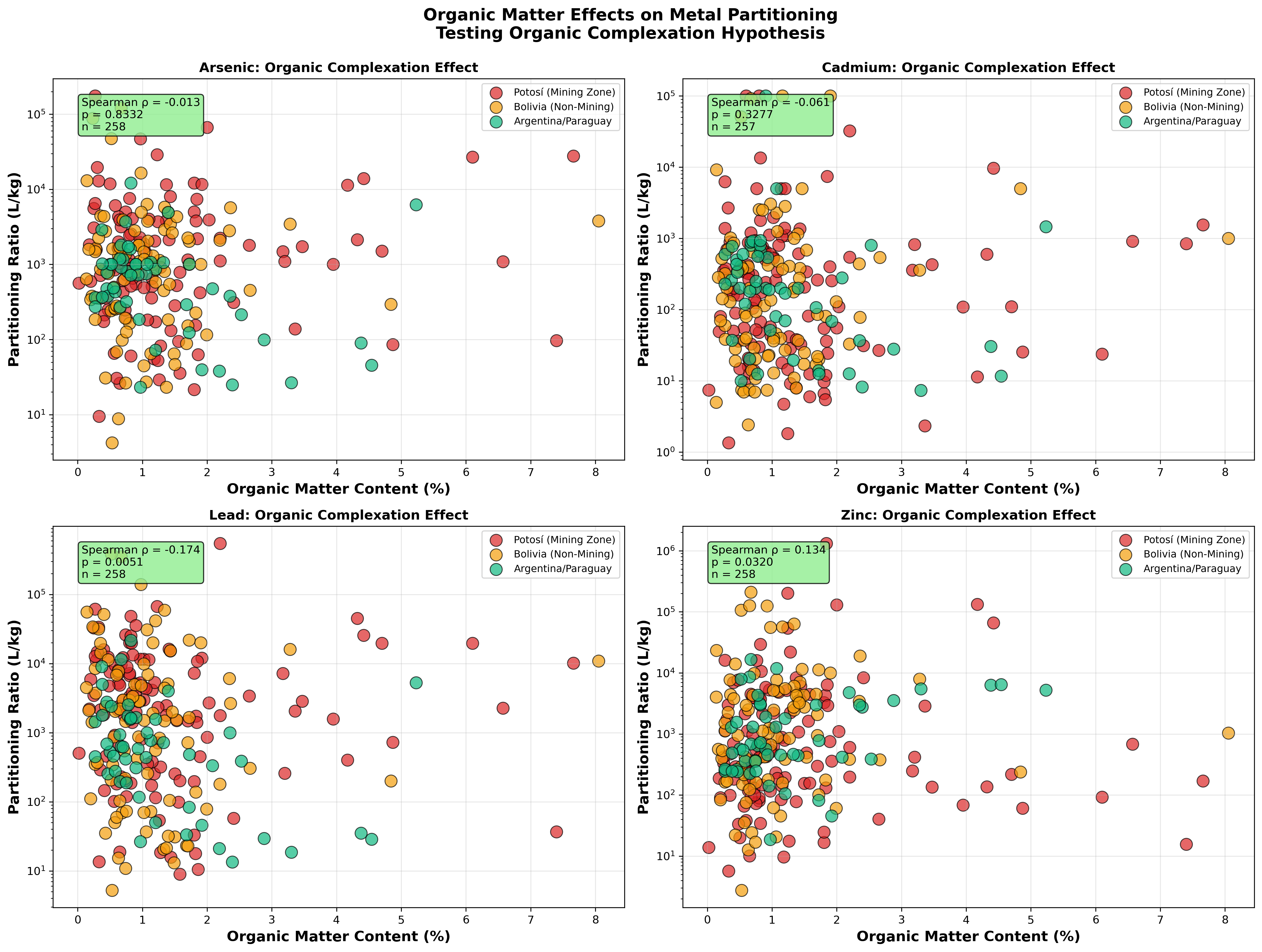
Organic matter (%) vs. Kd for all four metals. Zinc is the only metal with a positive OM signal (ρ = +0.134, p = 0.032, n = 258) — all other metals show flat or negative trends. OM throughout the basin is low (median ~0.9%), limiting OM's overall importance. Lead shows a weak negative trend (ρ = −0.174, p = 0.005) because OM-rich zones coincide with low-pH mining areas where all retention fails regardless of mechanism.
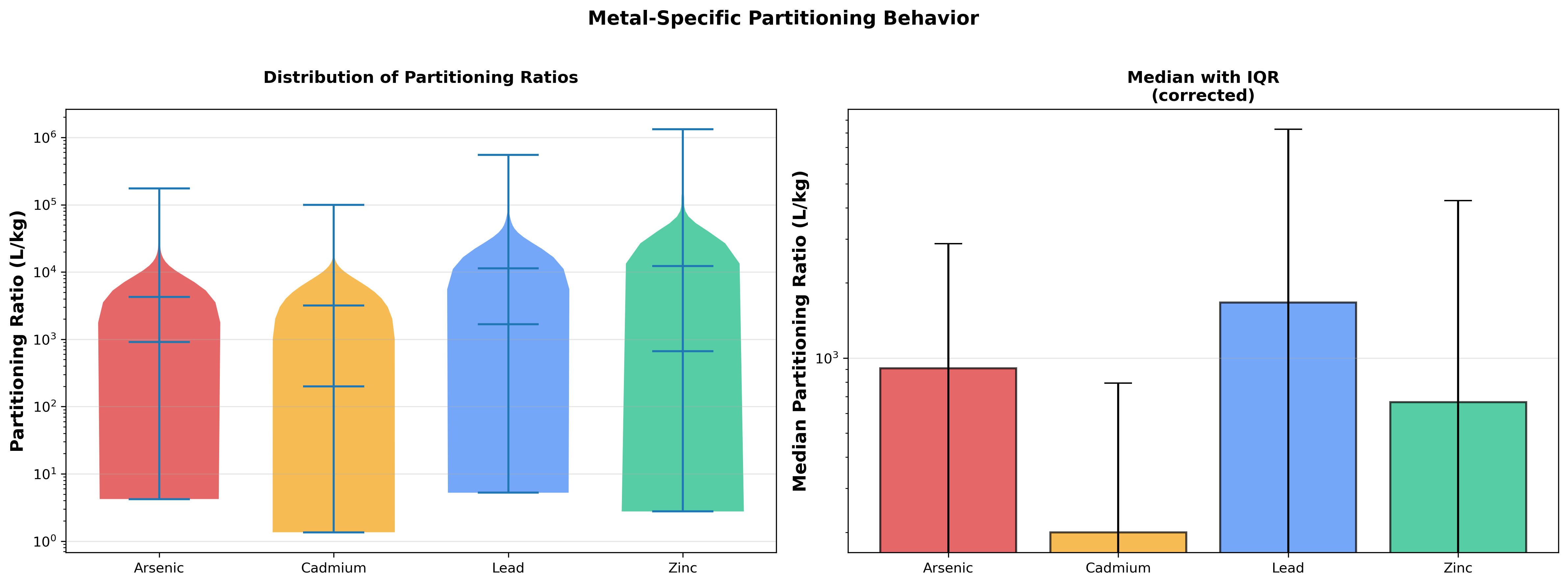
Kd distributions per metal across all stations (log scale). Zinc's wide interquartile range reflects its multi-mechanism binding: stations with high Fe, Al, clay, and phosphate all push Zn Kd upward through different pathways. Lead's extreme right tail (max 548,000 L/kg) reflects Mn oxide hotspots that create localized very-high-retention microenvironments near the mining headwaters.
pH and Dissolved Oxygen: The Overriding Controls
Every metal-specific binding mechanism described above operates inside a larger environmental frame. pH determines whether the binding-surface minerals even exist — acids dissolve Fe/Al oxides and Ca/P phases alike. Dissolved oxygenThe concentration of molecular O₂ dissolved in water. Reported in mg/L. Below ~4 mg/L, anaerobic microbial processes can begin reducing iron- and manganese-oxide minerals in sediment. determines whether those surfaces stay in their stable, metal-retaining oxidation states. These two variables explain more Kd variance than any single metal-specific pathway.
pH Effects on Kd — SpearmanA statistic that measures how monotonically two variables move together. Values range from −1 (perfectly inverse) through 0 (no monotonic relationship) to +1 (perfectly aligned). ρ
| Metal | ρ | p-value | Direction |
|---|---|---|---|
| −0.249 | <0.0001 | Strongest negative — low pH severely reduces Pb binding | |
| −0.216 | 0.0004 | Negative — acidity reduces As retention via oxide charge | |
| −0.197 | 0.0013 | Negative — acid dissolves Ca/P minerals retaining Cd | |
| +0.124 | 0.044 | Positive — higher pH creates more surface binding sites for Zn²⁺ |
Dissolved Oxygen Effects on Kd — Spearman ρ
| Metal | ρ | p-value | Mechanism |
|---|---|---|---|
| +0.251 | <0.0001 | Strongest — high DO maintains Mn oxides that bind Pb | |
| +0.206 | 0.0008 | Direct redox: high DO → As(V) → stronger Fe/Al binding | |
| +0.155 | 0.011 | High DO preserves Fe/Al/Mn oxides for Zn | |
| +0.132 | 0.033 | Weakest — DO indirectly benefits Cd via Ca/P stability |
All four metals show statistically significant positive DO correlations — higher oxygen means more metal stays in sediment. The mechanism is not direct: DO maintains Fe(III)/Mn(IV)/Al(III) oxidation states that form the mineral surfaces where sorption actually happens. When DO falls, those surfaces reduce and dissolve, releasing bound metals. Despite the significant correlations, basin-wide DO is already adequate — aeration would not improve outcomes.
| Redox Zone | DO Range (mg/L) | Events (n=264) | % of Total | Metal Behavior |
|---|---|---|---|---|
| Anoxic | < 2 | 1 | 0.4% | Fe/Mn oxides dissolve — metals mobilize into water column |
| Low-DO | 2–4 | 3 | 1.1% | Transitional — marginal oxide stability, partial metal retention |
| Oxic | > 4 | 260 | 98.5% | Fe/Mn/Al oxides stable — metals retained in sediment |
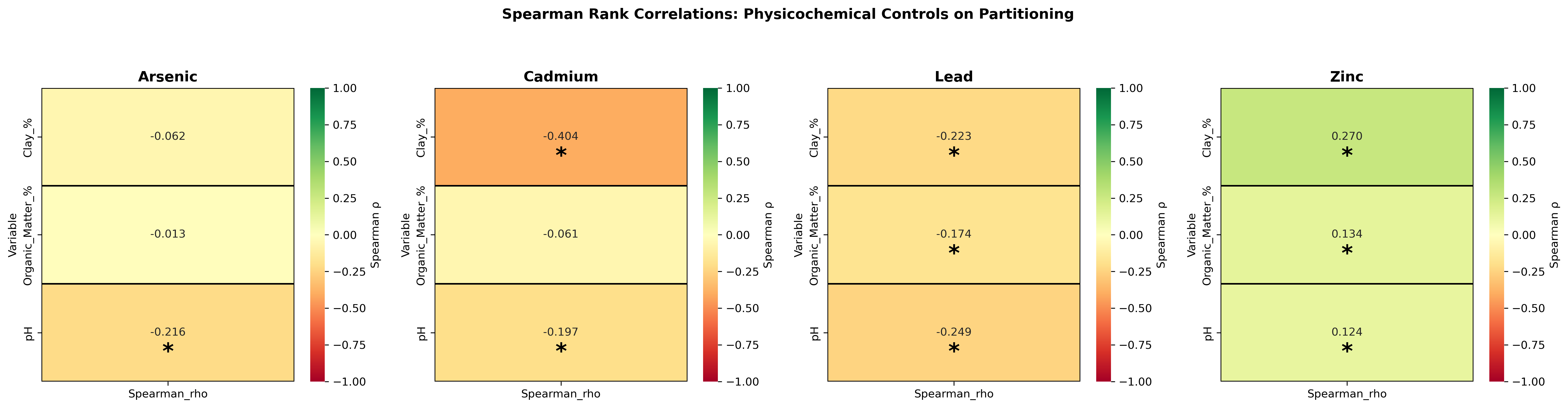
Spearman ρ heatmap: Kd vs. pH, clay, and organic matter across all four metals. pH signal is negative for As/Cd/Pb (acidity disrupts binding) and positive for Zn (cation-exchange site creation). Cadmium's clay correlation (ρ = −0.404) is the strongest signal in the empirical dataset — a sorption-site-saturation fingerprint unique to Cd. Organic matter shows only a weak Zn signal (ρ = +0.134); all other OM correlations are non-significant.
Spearman ρ matrix for mechanistic phase variables (Fe, Mn, Al, Ca, P, S) vs. Kd for each metal. Circle size encodes |ρ|; red = positive, blue = negative. Fe, Mn, Al columns light up for As and Zn; Ca and P columns are the dominant signal for Cd; Mn and P are the only verified controls for Pb. Cadmium's negative Fe cell (ρ = −0.132, p = 0.031) is the most diagnostically important value in the matrix.
From Mechanisms to Interventions
Understanding which minerals hold each metal — and which environmental conditions maintain them — converts abstract geochemistry into a targeting map for remediation. The binding mechanisms verified here define both the leverage points (where intervention can work) and the failure modes (what must not happen during treatment).
The single highest-leverage action across all four metals is pH amendment in the mining headwaters. Raising the Potosí zone from pH 3–5 to 6–7 would restore Fe/Al oxide surface charge for As and Zn, stabilize Ca/P minerals for Cd, and reduce H⁺ competition at Pb binding sites — simultaneously, without targeting individual metals. No other single intervention has this cross-metal reach.
For Pb specifically, protecting Mn oxide stability means protecting Pb's primary sediment reservoir from oxygen depletion. This has direct implications for any physical remediation that involves sediment disturbance — dredging or capping in oxic zones must be planned to avoid anoxic microenvironments, which would release Pb as rapidly as it was immobilized. For Cd, the negative Fe correlation is a warning against Fe-dosing treatment approaches: adding Fe minerals to improve Cd retention is not supported by this system's chemistry, and could actively worsen Cd mobility by competing with the Ca/P phases that actually work.
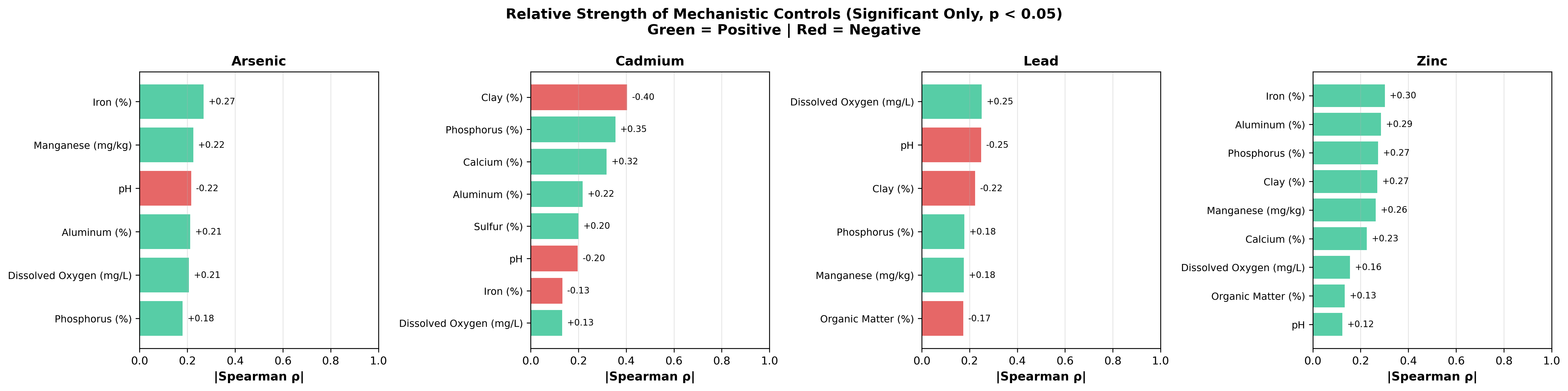
All statistically significant Spearman ρ values (p < 0.05) per metal, sorted by |ρ|. The visual immediately reveals the binding fingerprint of each metal: As and Zn have broad, positive oxide signals; Cd is dominated by Ca and P (with a uniquely negative Fe bar); Pb has only two confirmed controls — Mn oxides and phosphate — far fewer than the other metals despite its highest Kd. Bars reaching left (negative ρ) identify binding-suppression signals: Cd/Fe is the most diagnostically important. n = 265 for all metals (264 for Cd); mechanistic variables use n = 135 where subset data were available.
Continue Reading